Project
£25/mo +VAT · included from CoreJob costing with a baseline you can measure against
A budget that shifts every time somebody tweaks the estimate can’t show you variance against anything. So the baseline gets frozen on purpose, as a version, and re-baselining makes a new one rather than overwriting the old. Cost breaks down against your own cost code tree. Actuals land in six categories. On top of that sits a dated cost-to-complete forecast that reconciles against the baseline and the actuals both. Included from Core up.
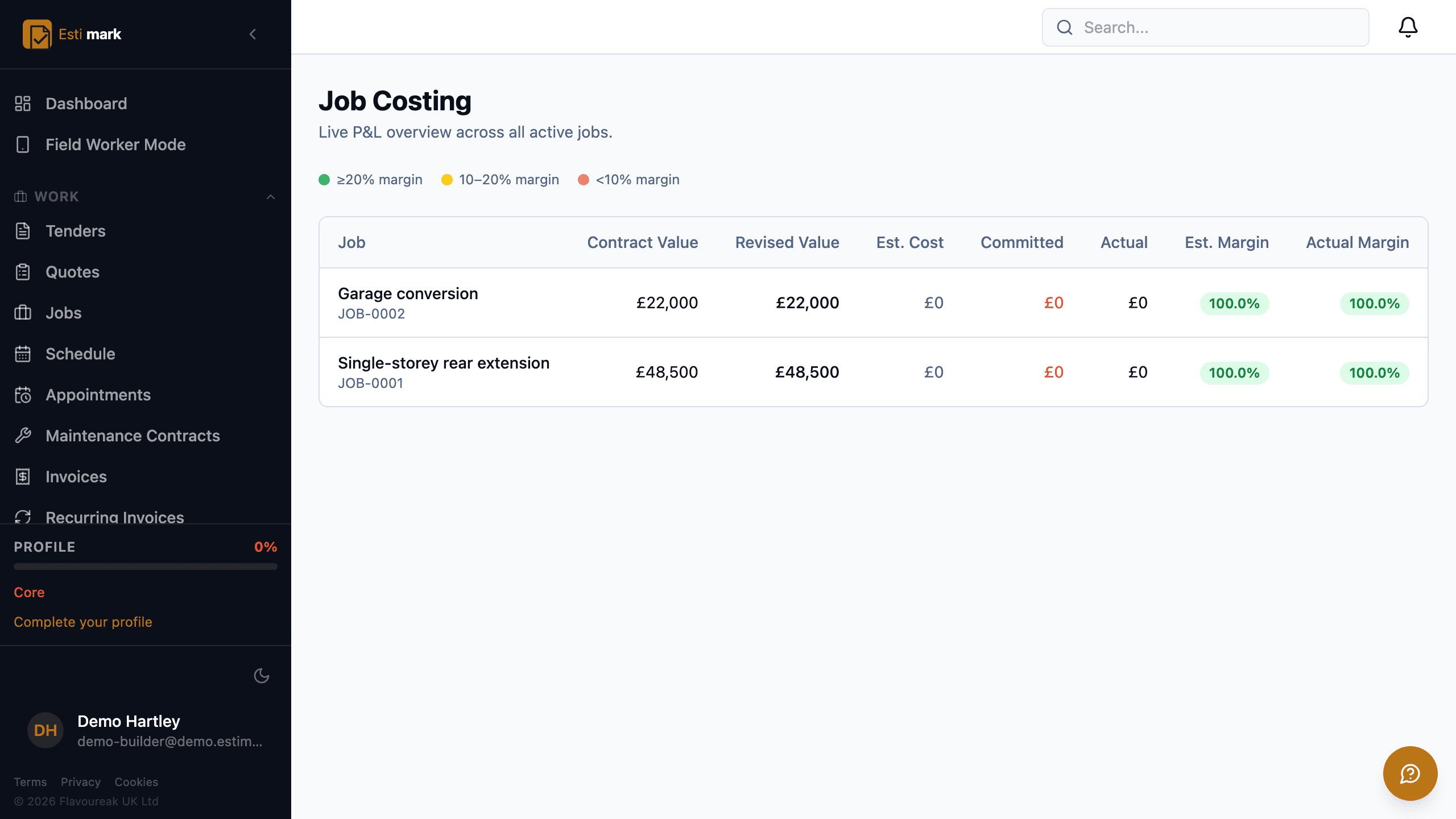
What the Job Costing module does
- Holds your cost breakdown structure as a tree: cost codes with a parent, a code, a name and a category.
- Freezes a job budget as a versioned baseline with a status of draft, active or superseded, and records who baselined it and when.
- Splits the budget into lines against cost codes and categories.
- Records actual cost entries against a job, a category, a cost code and a date, with a reference and an optional link to the purchase order that generated them.
- Costs hours clocked on site as they are recorded: the rate typed on the hours, else the person’s own cost, else their trade’s cost per hour, else a subcontractor’s agreed hourly rate.
- Counts hours with no rate rather than costing them at nothing, names whose they are, and costs them in one step once a rate is set.
- Takes an approved supplier invoice as the cost of what it bills, in place of the order’s price, so the same goods are never counted twice.
- Uses six cost categories: labour, material, plant, subcontractor, preliminaries and other.
- Holds a cost-to-complete and forecast final cost per cost code at a period end, with the author recorded.
- Treats forecast final cost as a dated commercial judgement rather than a sum the software worked out. Somebody has to make that call, and their name goes on it.
Job Costing: how it works
What is a CVR and how does Estimark support one?
A cost value reconciliation sets the value you’ve earned on a job against the cost you’ve incurred, at a stated date, so you get a real margin rather than whatever the bank balance implies. Estimark keeps the three inputs apart: a frozen baseline budget, actual costs by cost code and category, and a dated cost-to-complete judgement your commercial manager enters at period end.
- Baseline: frozen on purpose, versioned, and superseded rather than overwritten when you re-baseline.
- Actual: cost entries by date, category and cost code, including those generated from purchase orders.
- Forecast: a cost-to-complete and a forecast final cost per cost code at period end, with the name of whoever made the call.
How does Estimark cost the hours clocked on a job?
When they are recorded, from what each person costs you. A QR clock-out, a shift closed automatically when nobody signed out, a subcontractor’s sign-out or hours logged on a phone with no rate are costed in a fixed order, and the rate is kept on the hours so a later pay rise does not re-cost them.
| Order | Rate used |
|---|---|
| 1 | The rate typed on the hours, which always wins |
| 2 | The person’s own cost, set against them in Labour Rates |
| 3 | Their trade’s cost per hour, not the charge a quote uses |
| 4 | For a subcontractor, their agreed hourly rate |
- Hours nobody has a rate for are counted, not costed at nothing. The cost summary says how many hours have none, with See the hours to list whose they are, Set rates, and Cost them from current rates.
- A subcontractor on price work has no hourly rate, so their hours are not costed twice: their valuation carries the cost.
- The cost of a person’s hours is shown to those who can see labour rates or job costs, and nobody else.
NoteA person’s pay rate in HR is never used. It is their wage without employer’s costs, and for a salaried person there are no hours to divide it by.
Why does Estimark freeze the job budget instead of deriving it from the estimate?
Because a budget that recalculates itself from the estimate shifts every time the estimate does, and then nobody can say what the variance against the original was. So Estimark takes a snapshot and keeps it. Re-baseline and you get a new version with the old one marked superseded. What you thought the job would cost in March is still there in September.
What is a cost breakdown structure and why does it matter?
A tree of cost codes rather than a flat list of categories. Five flat categories can’t tell an M&E contractor what a system cost, and they hide the cost of a whole package. A parent-child tree of codes is all a CBS or WBS ever was. It gets you from "materials" to "materials, second fix, plot 14".
Job Costing: at a glance
- Plan
- Included from Core
- Add-on price
- £25/month +VAT
- Cost categories
- 6
- Budget
- Frozen, versioned baseline
Job Costing
£25per month +VAT
Job Costing is a bundled module. Plans are a ladder, so it comes with Core and with Pro, Enterprise. On a lower plan you can switch it on by itself for £25 a month.
Included from Core, £129 a month
- Included on Core and above at no extra cost.
- £25 per month as an individual module on a lower plan, excluding VAT.
- Included in full during the 14-day free trial.
- No implementation fee and no minimum term.
Questions
Job Costing: frequently asked
Which plan includes job costing?
It’s included from Core up. On a lower plan it’s £25 a month +VAT on its own.
Does Estimark calculate the forecast final cost for me?
No. Forecast final cost is a commercial judgement, not arithmetic. Estimark holds the judgement, dates it, puts a name to it, and reconciles it against the baseline and the actuals. That’s what a CVR is for.
Where do actual costs come from?
Timesheet hours, at the rate typed on them or what the person costs you. Deliveries booked in against purchase orders, then the supplier’s invoice once it is approved. Approved expense claims. Van stock booked to the job. And entries somebody types in directly. Every one of them arrives with a date and a category.
Can I re-baseline a budget mid-job?
Yes. You get a new budget version and the old one is marked superseded, so "how does this compare with the original" is still a question you can answer.
Related
Payment Applications
The value side: interim applications, certification and retention.
Purchase Orders
Committed cost from open orders.
Timesheets
Labour hours at a rate, booked to the job.
For builders & contractors
Pro at £299/month +VAT. Payment applications, HR, training, plant and fleet.
Job costing & CVR
Actual, committed and forecast cost per job, with a cost value reconciliation pack.
Payment applications & retention
Interim applications, retention, payment and pay-less notices under the Construction Act.
Pricing & plans
Solo £39 +VAT, Core £129 +VAT and Pro £299 +VAT a month plus seats. Enterprise is quoted. Bolt-ons are priced separately.
Try it on a real job.
14 days, full access, every plan. No implementation fee. All prices exclude VAT, added at 20% at checkout.