Step 11 of 15 · Money
Get paid
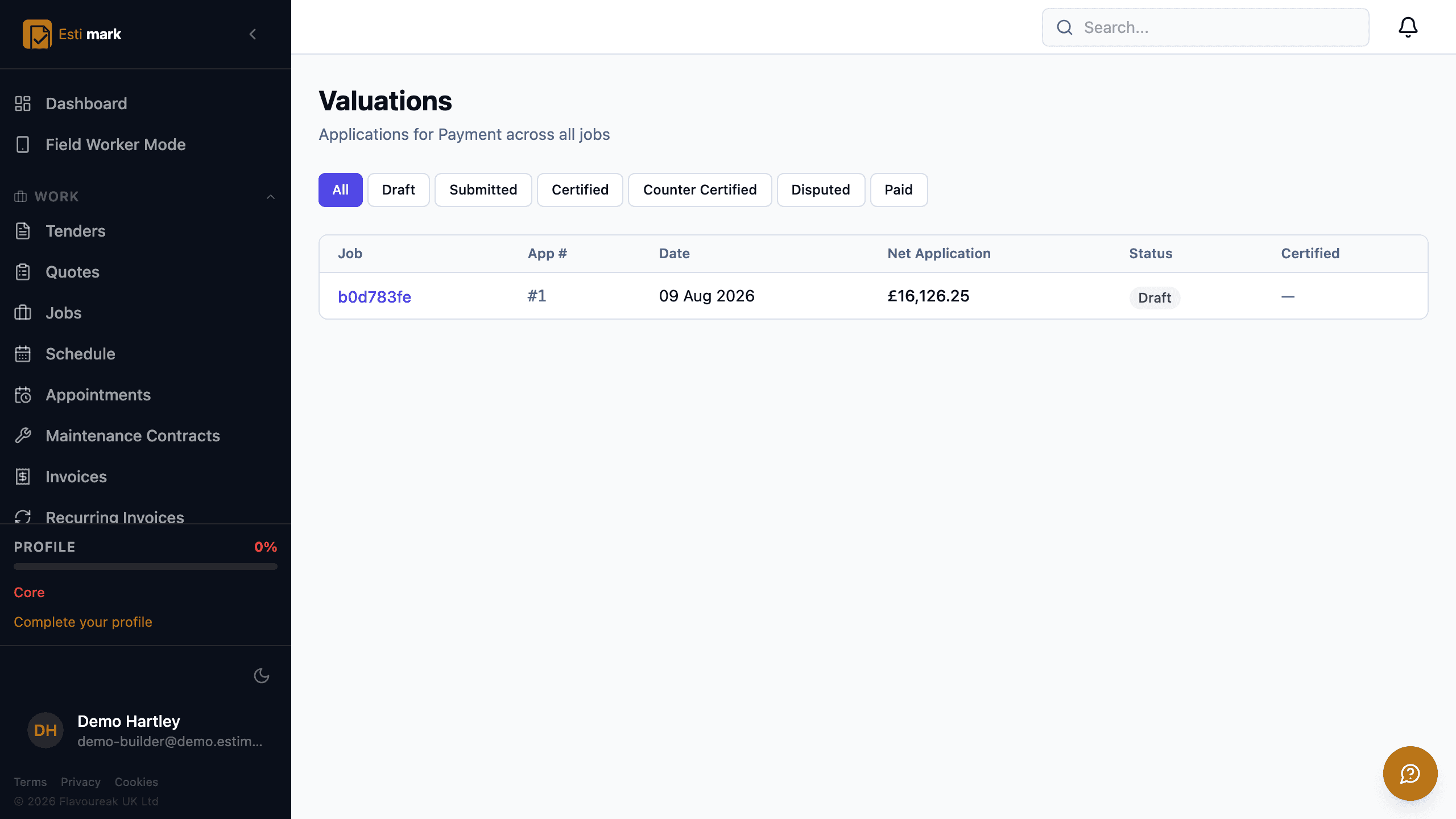
An application for payment is an interim claim for the value of work done to date, and Estimark builds one from the cumulative gross valuation, less what has already been certified, less retention. Each application carries its number, its date, its net figure and its stage, through draft, submitted, certified, counter certified, disputed and paid. The dates come with it: the payment due date, the final date for payment, the five days a payment notice has under section 110A and the prescribed period for a pay less notice under section 111. Retention is held per job and released on the stages your contract sets.
- 01
What goes into an application for payment?
The cumulative gross value of everything done so far, less the amount previously certified, less retention, which leaves the net application. Applications are numbered in sequence per job, so number four reads against number three rather than standing alone. The stage filters tell you what is out, what has been certified, what has been certified at a different figure and what is in dispute.
- 02
Which notice dates does Estimark track?
The payment due date and the final date for payment on each application, the five-day window a payment notice has under section 110A, and the prescribed period for a pay less notice under section 111. A pay less notice entered after its period has run is refused rather than filed, because a late notice is ineffective and the notified sum stays payable in full. Getting that wrong is expensive in exactly one direction.
- 03
How is retention tracked and released?
As a percentage on the job, deducted on each application and totalled as the amount held. Release follows the stages your contract sets, with the balance tied to the defects liability period where the contract does that. The point is that the held figure is visible per job all the way through, so the last slice gets asked for instead of quietly written off.
- 04
How does the certified figure become an invoice?
The invoice follows the certified sum and stays linked to the same job, so the application and the invoice never drift apart. Invoicing, CIS deduction and the VAT reverse charge are the next step of this tour.
- Application
- Cumulative gross, less certified, less retention
- Notices
- Section 110A and section 111 dates tracked per application
- Retention
- Held per job, released on your contract’s stages
What this step does not do
- A client can’t pay an invoice by card from inside Estimark yet.
Questions
Money, frequently asked
Is an application for payment the same as an invoice?
No. An application claims the value of work done in a period and asks the other side to certify it. The invoice follows the certified sum. Estimark keeps both and links them to the same job.
What happens if a pay less notice is served late?
Estimark refuses to record it against the application. A pay less notice served after its prescribed period is ineffective, and the notified sum stays payable in full.
CIS deductions come off the labour element of a subcontractor’s payment and nothing else, so Estimark takes materials, VAT, plant the subcontractor hired in and the CITB levy out of the base before it deducts anything.
Build on a solid foundation.
Run the whole business without an implementation project and without legacy baggage. Every plan starts with 14 days free.
Estimating · Jobs · Invoicing · CIS · H&S · Reactive maintenance