Step 15 of 15 · Housing
Repairs and the compliance register
Housing repairs software needs a property register underneath the job list, and that is what the four housing bolt-ons add. A reported repair is raised against a property, triaged, given a priority from routine up to emergency, and run against response and completion clocks. Landlord safety obligations sit per property with a next-due date, so a gas safety record, an electrical installation condition report or a fire risk assessment reads as in date, due soon or overdue. Certificates are filed by type with their dates and results. An empty property opens as a void at keys-in and is measured through to re-let.
- 01
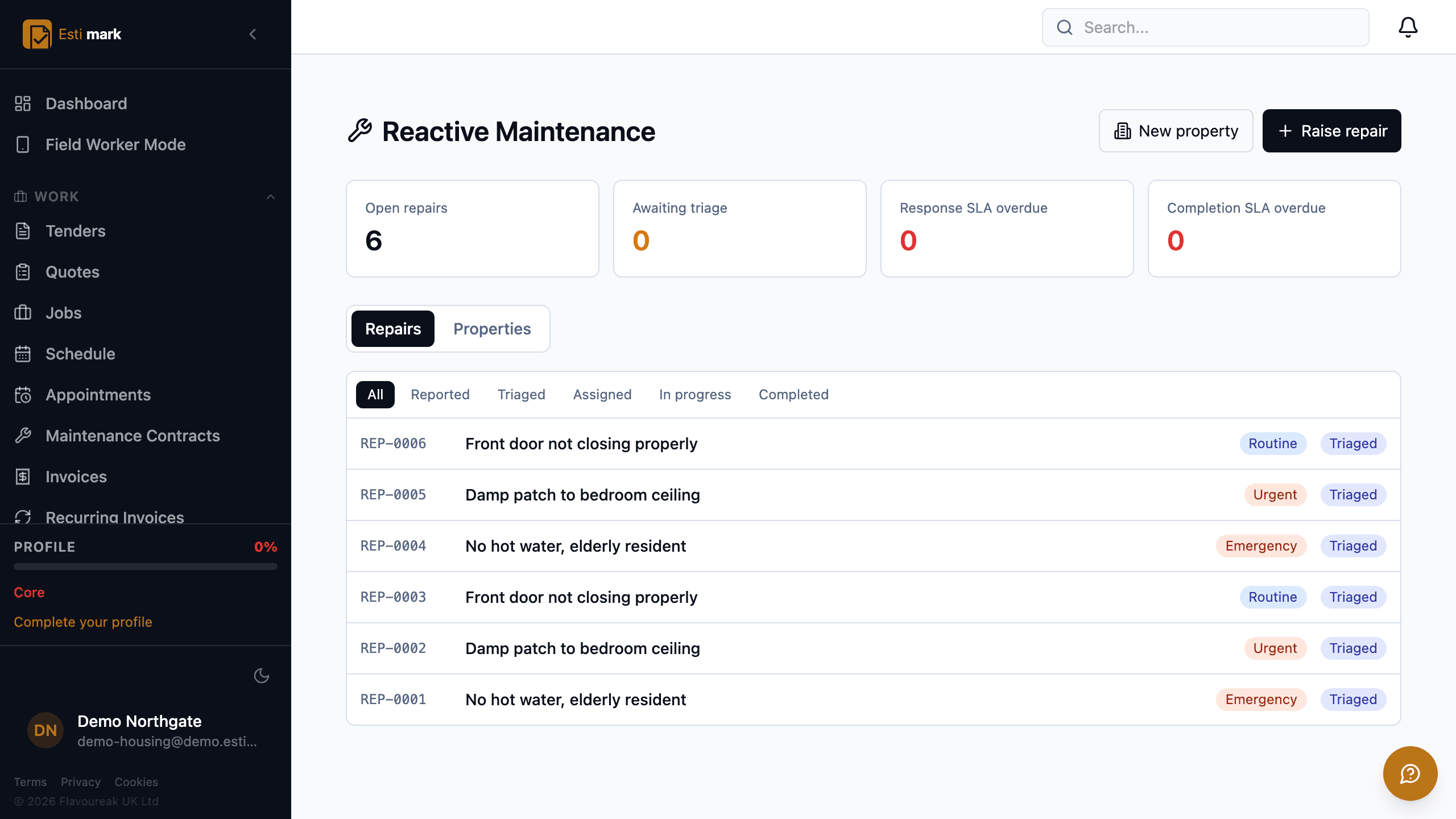
How does a reported repair reach an operative?
It comes in against a property, gets triaged, and takes a priority. From there it is assigned, in progress, then complete, with two clocks running: one for the response and one for the fix. The counters at the top show how many of each are past their target. Those targets are the ones in your contract, set per priority rather than assumed by us.
- 02
What does the compliance register hold?
One row per obligation per property. Gas safety record, electrical installation condition report, fire risk assessment and whatever else your contract names, each with the date it was last done, the date it falls due again and where it stands. The screen totals what is overdue, what is due soon and which property is worst. It is a register: it holds dates and documents and tells you what is late.
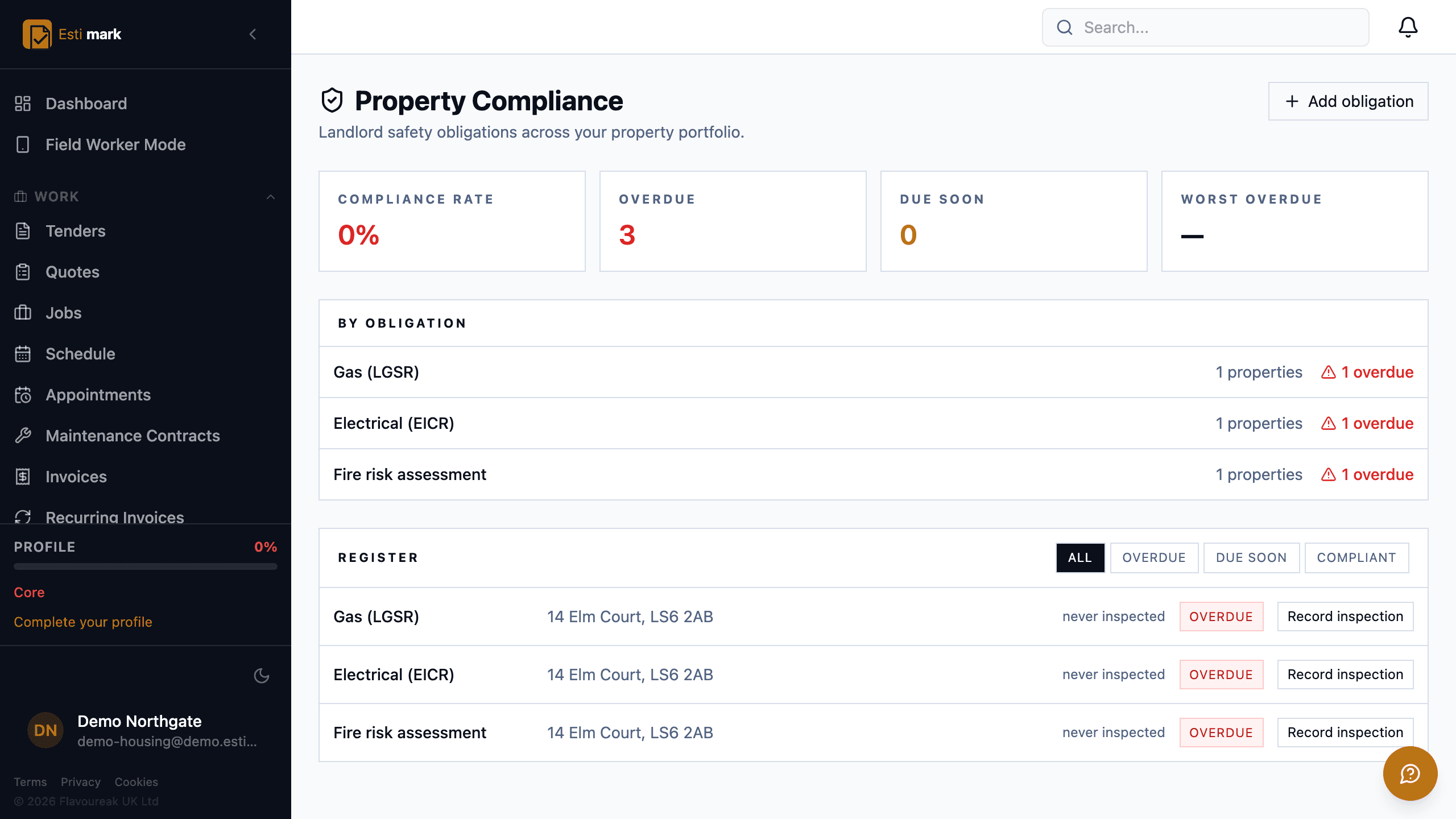
The property compliance register, grouped by obligation, showing gas, electrical and fire risk assessment items with an overdue count against each property. - 03
Where do the certificates themselves live?
In a register filed by type, covering EIC, EICR, minor works, CP12, gas soundness, PAT and other. Each certificate carries its number, the property, who issued it, the date it was issued, an expiry date where it has one, and a pass or fail, and the document downloads from the row. When a client or a regulator asks for one, it is a search rather than an afternoon.
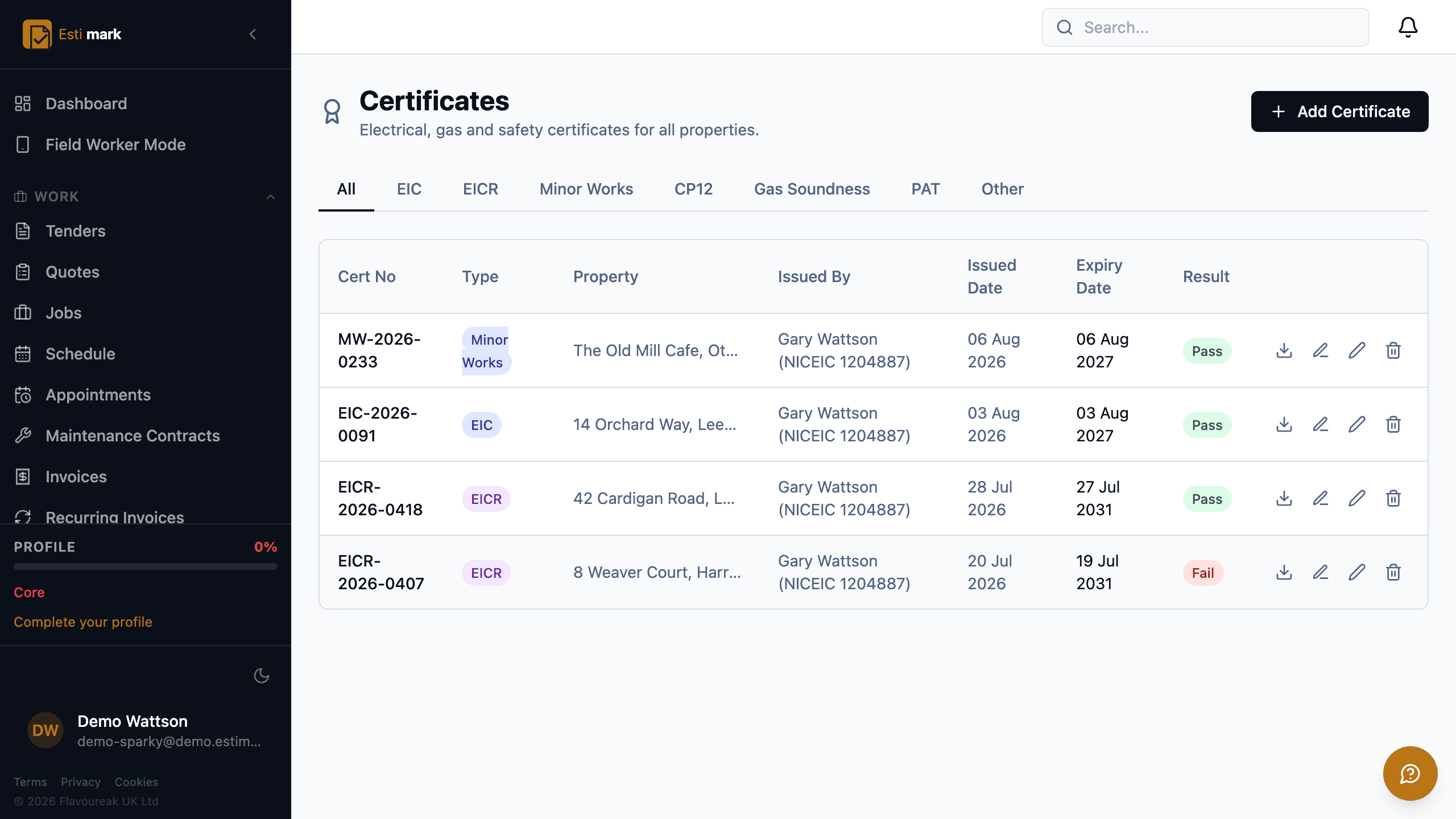
The certificate register filtered by type, listing EICR certificates with the property, who issued them, the issue date and the result. - 04
How is a void turned round?
You open the void when the tenancy ends, and the turnaround clock starts at keys-in. Works run against the void, and the screen reports open voids, how many are past your target days, average days void and average turnaround to re-let. Every day a property stands empty is rent nobody collects, so the number belongs somewhere it gets looked at.
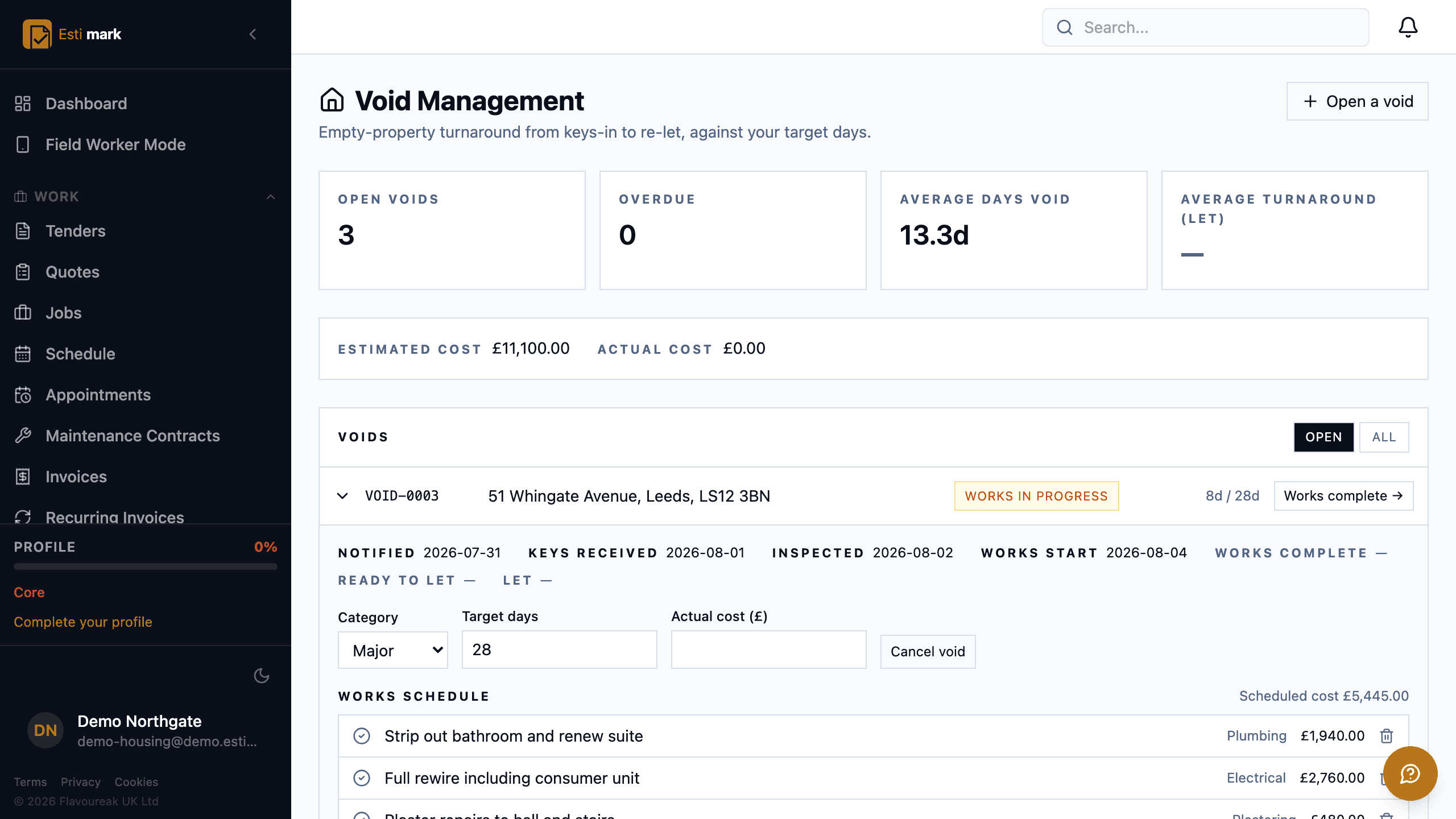
Void management, with open and overdue counters above two voids at the notified stage, each waiting on keys received. - 05
How are the repairs priced?
From a schedule of rates, the same coded rate set covered in step one of this tour. A measured repair picks its code and snapshots the rate, and the client uplift percentage on the rate set carries through, so the invoice matches the contract you signed.
- 06
Does it handle Awaab’s Law?
Yes, as a statutory register of its own sitting beside the repair ticket, on the same reactive maintenance bolt-on rather than behind a second one. Awaab’s Law is the name everybody uses for the duties in The Hazards in Social Housing (Prescribed Requirements) (England) Regulations 2025, and Estimark opens a case per issue of concern against the property. The clock is anchored on the day the landlord became aware rather than the day somebody raised a ticket, so a stock condition survey, a gas engineer’s visit or an environmental health referral starts it the same as a phone call, and the evidence for that date is recorded next to it. Regulation 6 counts 10 working days from the day after awareness for the investigation, and a resident asking for a physical inspection restarts it under regulation 7. Damp, mould and fungal growths have been in scope as a significant hazard since 27 October 2025, and nine more HHSRS hazard categories join them on 30 November 2026, so the case records which hazard it is and Estimark knows whether that hazard was in scope on the day it was reported.
- 07
Who works out the deadline, you or the software?
Estimark does, from the facts, and none of the statutory dates can be typed into a date field. Completing the investigation starts three more clocks: regulation 9 gives 3 working days for the written summary to the resident, regulation 11 gives 5 for making the home safe, and regulation 13 gives 5 to begin preventative work with a 12-week backstop counted in calendar days. An emergency hazard runs on 24 wall-clock hours under regulation 5, through nights and weekends. That one therefore gets a two-hourly sweep and an alert of its own rather than a place in the daily digest. Working days are counted as regulation 2 defines them, skipping weekends, Christmas Day, Good Friday and England and Wales bank holidays from a table shipped with a stated expiry, and past that expiry the calculator refuses to count rather than guess a bank holiday it does not know about. Your own target sits next to the statutory one, and a target longer than the statute is refused on entry rather than quietly saved.
- 08
What does the resident get told, and what if they have to move out?
The written summary is raised the moment an investigation is marked complete, with its deadline already on it, rather than when somebody remembers. It holds what regulation 9 asks for: whether a hazard was found and what it is, what happens next with target dates for starting and finishing, or the reasons no further action is needed, and how the resident can contact the landlord. Estimark refuses to record it as given until those are filled in, and recording it takes the date and the method (in person, left at the property, first class post or electronically), because regulation 10 turns on delivery rather than on the resident reading it. The text as sent is kept verbatim, so what the household received can be produced later instead of reconstructed. Where the work will not be finished inside the initial remediation period, the rehousing duty is recorded against the case with the date it started computed from that period, and offered, accepted, declined and ended are four separate facts with four separate dates. Households in alternative accommodation are counted on the dashboard, and a deadline that has passed is reported plainly: there is no score, no rating and nothing that says whether a landlord complied, because that is a question for a county court on evidence this product does not hold.
- Repairs
- Priority, response clock and completion clock per job
- Register
- Gas, electrical, fire risk and your own obligations
- Voids
- Clock from keys-in, days void and turnaround reported
What this step does not do
- These four are bolt-ons rather than plan features, and they’re quoted rather than list priced, because a repairs contract is sized to the stock and the SLAs it covers.
- Estimark holds the dates and the documents. Deciding which obligations apply to your stock, and on what interval, stays with the landlord.
- The statutory clocks are not yours to enter: 24 hours on an emergency hazard, 10 working days to investigate, 3 for the written summary, 5 to make safe and 5 to begin preventative work with a 12-week backstop, all computed from the case, none of them a field anybody can type into. You can set a tighter internal target beside the statutory one and a looser one is refused on entry. What Estimark will not do is tell you whether you complied. A passed deadline is recorded with the date it passed, and that judgement is not ours to make.
Questions
Housing, frequently asked
Do I need the housing bolt-ons if I only do private work?
No. Tenders, quotes, jobs, timesheets, applications and invoicing cover a private contractor. The housing bolt-ons add a property register, repair priorities and clocks, a compliance register and voids, for contracts where the stock is the thing being managed.
Does the compliance register make us compliant?
No. It records what was done, when, by whom, and what is overdue. Deciding which obligations apply to your stock, and on what interval, stays with the landlord.
Build on a solid foundation.
Run the whole business without an implementation project and without legacy baggage. Every plan starts with 14 days free.
Estimating · Jobs · Invoicing · CIS · H&S · Reactive maintenance