Step 12 of 15 · HMRC
Settle up with HMRC
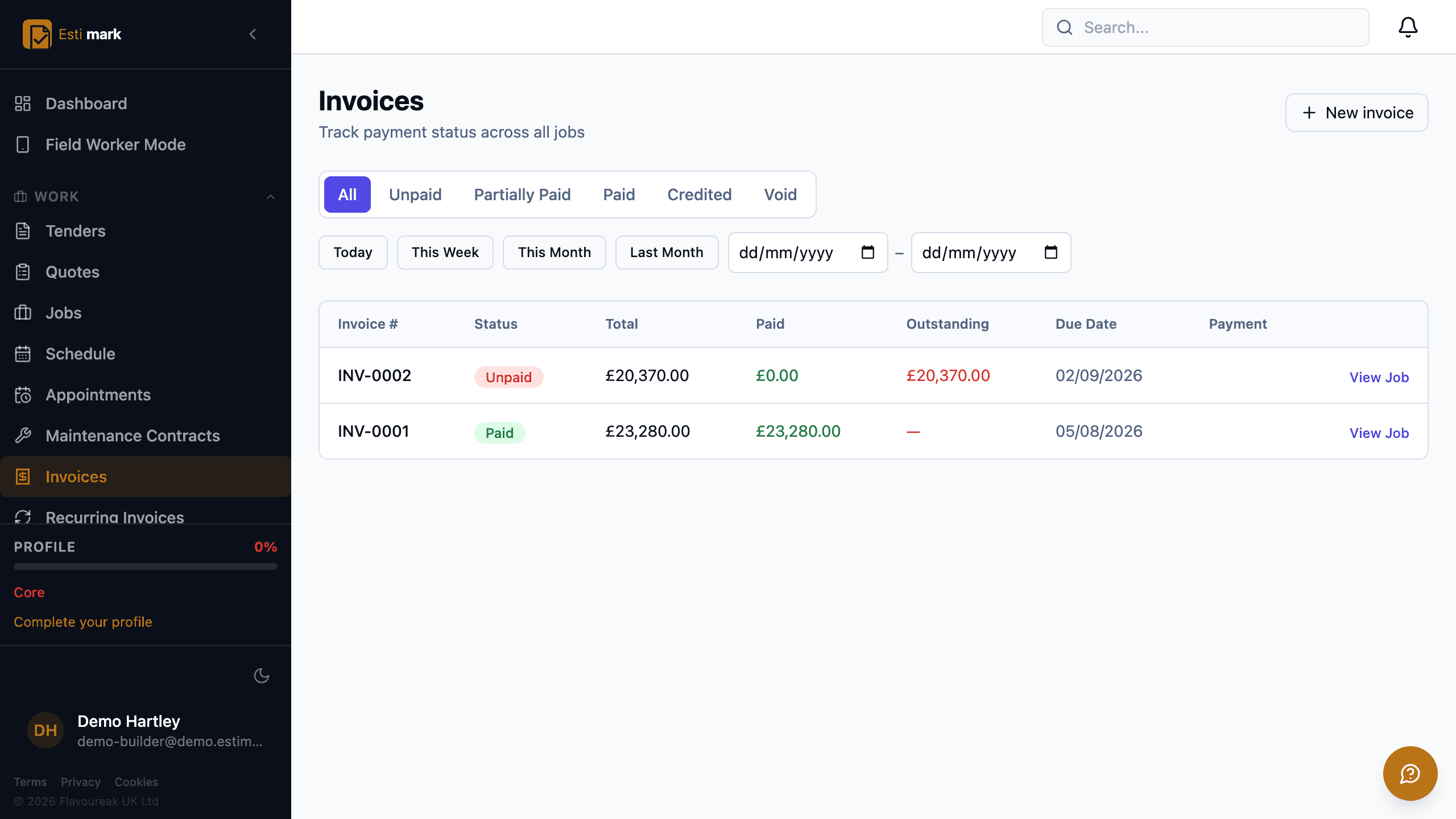
CIS deductions come off the labour element of a subcontractor’s payment and nothing else, so Estimark takes materials, VAT, plant the subcontractor hired in and the CITB levy out of the base before it deducts anything. The rate follows the subcontractor’s status: 20% once HMRC verifies them as registered, 30% where verification fails, and nothing at all where they hold gross payment status. Tax months run from the 6th of one month to the 5th of the next, and the monthly return is due by the 19th. On the sales side, every invoice keeps net, VAT rate and VAT amount apart, and a reverse-charge invoice carries no VAT plus the wording section 55A of the VAT Act 1994 requires.
- 01
How does Estimark work out a CIS deduction?
It builds the base first, then deducts. Materials, VAT, plant the subcontractor hired in and the CITB levy come out, which leaves the labour element, and the rate applies to that: 20% for a subcontractor HMRC verifies as registered, 30% where verification fails, nothing where they hold gross payment status. Deductions total per subcontractor per tax month, the shape both the monthly return and the subcontractor’s own statement need.
- 02
Why do CIS tax months not match calendar months?
Because they run from the 6th of one month to the 5th of the next, following the tax year rather than the calendar. Estimark counts the month that way, so a payment made on the 3rd falls into the month that ends on the 5th rather than the one that started on the 1st. The monthly return is due by the 19th, and a nil month still has a return to make.
- 03
When does the VAT domestic reverse charge apply?
It depends on the supply and on the customer: whether the work is a construction service reported under CIS, whether the customer is registered for VAT and for CIS, and whether they are an end user. That answer belongs to the client, so Estimark holds it on the client record rather than asking somebody to decide again on every invoice. A reverse-charge invoice then shows no VAT, states the rate the customer has to account for, and carries the wording section 55A of the VAT Act 1994 requires.
- 04
Where do the labour figures come from?
Approved timesheets, logged against the job by the person who did the work. The labour element of a payment and the labour cost in job costing read off the same hours, so the CIS base isn’t a second set of numbers typed in from a different sheet.
- 05
Does the invoice reach the accounts system?
Yes. Invoices push to Xero, QuickBooks and Sage Business Cloud, and payment status comes back each day, so the unpaid list in Estimark matches the one your bookkeeper is looking at. Statuses cover unpaid, partially paid, paid, credited and void.
- CIS base
- Labour only, after materials, VAT, plant and the levy
- Tax months
- 6th to the 5th, return due by the 19th
- Accounting
- Xero, QuickBooks, Sage Business Cloud
What this step does not do
- Estimark records a CIS300 with its statutory declarations. It doesn’t file it with HMRC.
- There’s no Making Tax Digital VAT submission.
- Estimark runs payroll from approved timesheets, totalling gross, PAYE, employee and employer NI and net pay per worker. It doesn’t file an FPS or an EPS with HMRC under RTI and it doesn’t produce payslips, P60s or P45s: the run exports for Sage 50, as a P32 summary or as an RTI-shaped file, and the filing stays with whoever files yours.
- The PAYE and NI figures on a run are an estimate for checking a wage bill, worked out on basic-rate thresholds rather than each worker’s own tax code, and pension contributions are not calculated. Payroll software or a bureau still produces the statutory figures.
Questions
HMRC, frequently asked
Is CIS deducted from materials?
No. Materials, VAT, plant the subcontractor hired in and the CITB levy come out of the base first, and the deduction applies to the labour element that is left.
Does Estimark file my CIS return?
No. Estimark records a CIS300 with its statutory declarations and totals the deductions per subcontractor per tax month. Filing it with HMRC stays with you or your accountant.
Job costing software answers one question, and Estimark puts the answer on a single row per job: contract value, revised value, estimated cost, committed, actual, estimated margin and actual margin.
Build on a solid foundation.
Run the whole business without an implementation project and without legacy baggage. Every plan starts with 14 days free.
Estimating · Jobs · Invoicing · CIS · H&S · Reactive maintenance